

There was a time not so long ago that we walked to reach our destination. We heard only what was within our vicinity. And saw only the horizon in front of our eyes.
And overnight, all of that disappeared. Well, kind of. A hundred years is nothing from a behavioral standpoint. We simply don’t evolve that fast. Our instincts and wiring haven't caught up — and they won't anytime soon.
So, looking at where technology has gotten us today, it feels like we live in a world no longer within reach. The speed of change has kept us preoccupied.
Our default tendency is to slip into the romance of the old days, hoping that the safety of our old behavior will save us. And when that doesn’t work, we crumble under the weight of overwhelm. Then discouragement. And ultimately get so stuck that we do nothing. Instead of gaining traction, we keep falling behind. And it becomes so easy to blame technology for it all because the alternative is more difficult to admit.
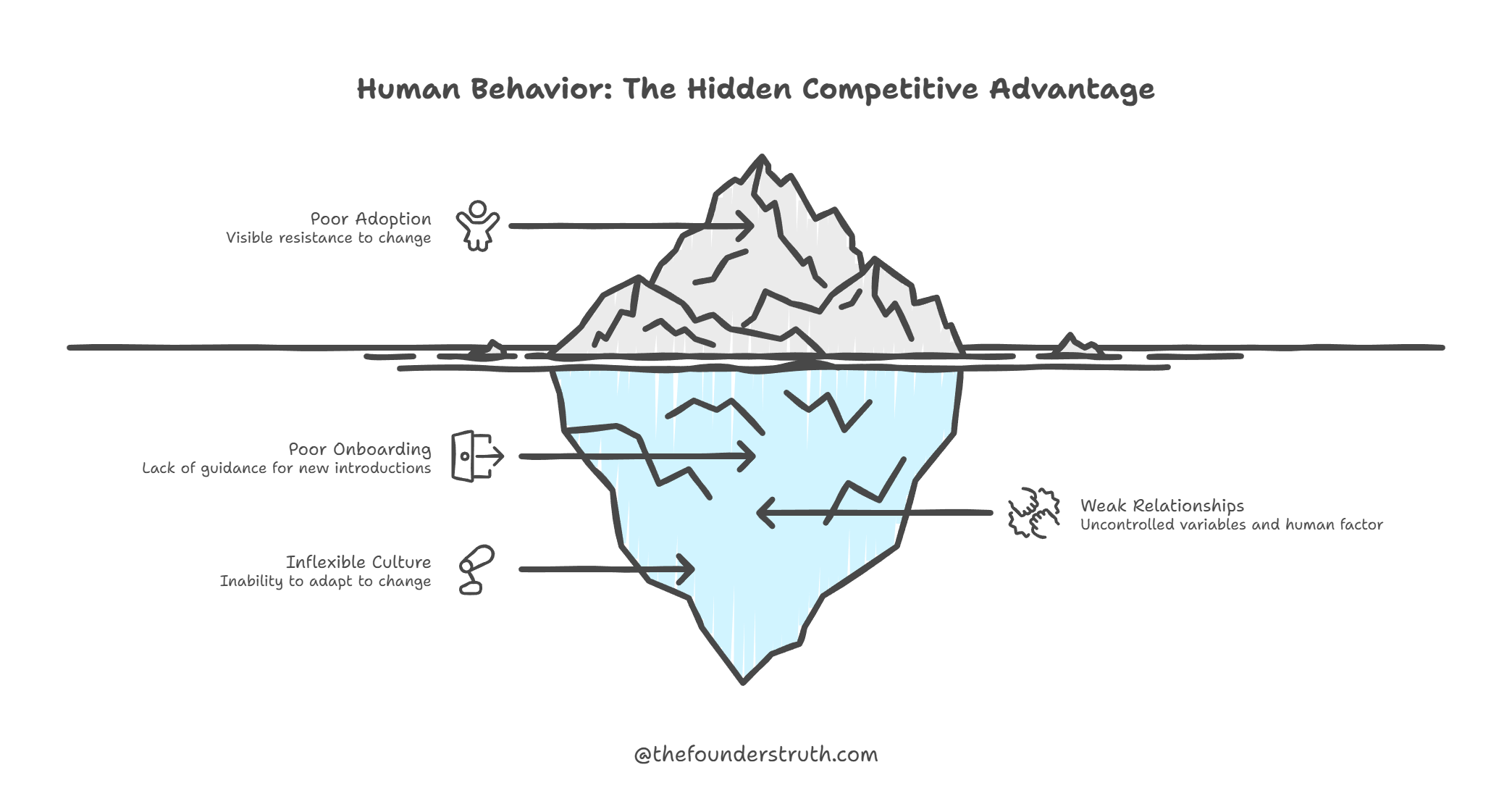
Yet, after 20 years of building digital ecosystems, whether by hand or transforming organizations to do so, the pattern is always the same. Technology is not the complex system in this equation. Human behavior is.
Our resistance, our fear, our psychological defaults under pressure — that's where the real obstacle lives. And until we're honest about that, no amount of better tools will close the gap.

How to capitalize on it?
Optimizing for human behavior is where the real competitive advantage lives. As AI accelerates the commoditization of tools and capabilities, three investments remain durable regardless of what technology does next.
1. Onboarding is the golden bridge.
Every time something new is introduced, a behavioral gap opens that is rarely addressed. It presents as poor adoption or resistance to change, yet most often it is poor onboarding or, in most cases, no onboarding at all. The integration stage becomes a bottleneck as real-world needs clash with the ambitious solutions. This dissonance is where the investment stalls and the transformation loses momentum.
2. Relationships for derisking.
Most risk lies in the multitude of variables you cannot control. No technology or capital can help you there, because the biggest variable is always human. By investing in relationships, you activate deeply human instincts — the sense of obligation, the willingness to share information selectively, and the tendency to prioritize those within your circle when things get difficult. Build that capital before you need it, because when volatility hits, it is the most underleveraged derisking strategy available.
3. Adaptable culture is the engine.
Technology can be replicated. With AI, sometimes within months. What cannot be replicated at the same speed is the behavioral infrastructure of an organization — how it absorbs change, makes decisions under pressure, and onboards new realities without losing cohesion. The delta between how long a transition was supposed to take and how long it actually took is your culture tax. Invest in that infrastructure, because it is the only competitive advantage that gets stronger the more disruption you absorb.
Why does it work?
Because focusing on the least volatile component in the system is a long-term strategy that compounds. It sounds absurd that the slowest cog wheel, our human behavior, becomes what sets the foundation to handle the speed of everything else.
Technology moves fast, which means any advantage it creates is, by definition, temporary. Once established, human behavioral patterns are sticky and hard to replicate.
As every tool becomes a legacy system. Every competitive advantage enabled by technology gets commoditized. Every market shifts. What does not depreciate at the same rate is the behavioral muscle.
Thus, proper onboarding increases adoption rates while simultaneously improving stickiness — not through lock-in tactics, but through genuine integration into how people work.
The trust infrastructure built through the right relationships grows over time, opening more doors and opportunities, reducing exposure to risk.
And a system where humans are well-oriented behaviorally can absorb new tools and disruptions more easily, because the underlying operating logic stays intact even as the surface-level technology changes.
What cannot keep pace with the speed of technology is precisely what keeps it in check.
Understanding the system is the easy part. Living inside it is another thing entirely. And the best part is that all you need, you already know — the only problem is that in that moment, it will feel as if you are behind, have no control, and are ready to spiral back into overwhelm. Holding steady while living inside the disruption becomes essential.
What to expect and how to hold through it?
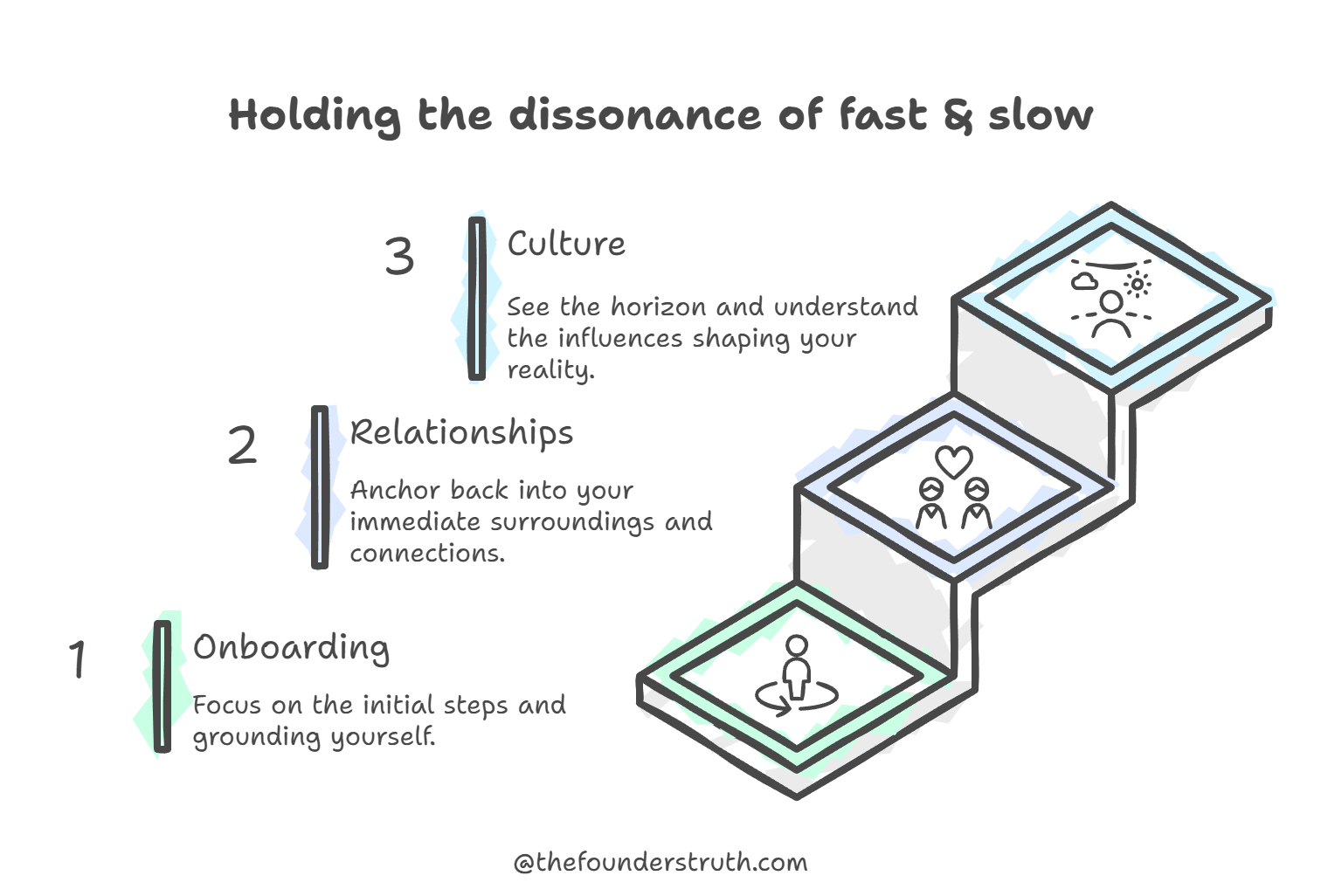
Leaning into the human, this is going to sound poetic and doesn’t have answers. Instead of resolving the dissonance, we will embrace it and rely on old behaviors not as a romanticized fantasy of what’s old is better but as a recalibration mechanism that forces us back into what’s real and close.
Walk to reach your destination. Every time you feel overwhelmed, slow down and find your footing. What is the next step I can take? Where am I? Can I do this alone? — Focus on the onboarding.
Hear only what’s within your vicinity. Anchor back into what influences you. Who/What is around me? Who/What to remove or add? When I move what stays close, what shifts? — Focus on the relationships.
See the horizon in front of your eyes. You can handle only what you can see. What behaviors and constraints are shaping my reality (good or bad)? Where do I feel more comfortable and supported? Where can I find what excites me? Focus on the culture.
The Behaviors in Action
We came to believe that logic and analytical rigor are where our answers live — and so we reach for them first, especially when disoriented. Yet what we overlook is that our emotional and philosophical capacities are no less potent in shaping our reality — and require as much, if not more, tending to keep moving.
That is the aliveness adaptive behavior creates. Instead of playing catch-up to every trend and shiny new thing that comes your way, you are proactively shaping the foundations to handle any disruption.
Technology won’t slow down.
The behaviors will lag behind.
But now whatever comes next is within reach.
That’s The Founders Truth: Ambiguity, Absurdity, Aliveness.
And you can experience it today. What feels most out of reach right now?
Have a great day,
Carlo Mahfouz
P.S. I had a great conversation with Dave Van Bennekum about how we communicate differently when the environment shifts — and why that's harder than it sounds. Listen!
P.P.S. Struggling to Make Decisions When Bandwidth Is Scarce — I wrote about it last week. Read.
P.P.P.S. On Saturday, March 7th, Vjera Orbanic and I are hosting a workshop on Digital Presence by Design. Sign up here.