

Until you encounter (Recommended), you won’t understand how frustrating it is to be asked irrelevant questions.
I’m tired of it. So much so that I’m at the edge of blasphemy, ready to blame everyone and anyone.
And as it happens, lately, the one I blame for this resurgence of nonsense is a French dude I talk to more than my partner. Claude, it calls itself.
Not a fan.
Especially when it always thinks it is right.
It is as if a marketing agency married a forecasting engine and the child came out fluent, confident, and with no idea what it’s talking about all at the same time.
The crazy part: that’s exactly what happened.
The confusing part. It’s that I kind of like it while simultaneously hating it.
And in between the crazy and the confusing, a debt is rising, whether in you, your team, or your organization, and by the time you figure out what’s at play, it will be too late.
Welcome to the circus.
Ben requires no introduction, even though he is the last person I thought would get this.
In an interview back from 2024, he gave a relatable explanation of what AI is and isn’t, saying: “AI is a craftsman at best. A craftsman can learn to make Stickley furniture by sitting beside somebody, seeing what their technique is, and imitating. That’s how LLMs basically work.”
He followed with a more technical explanation, which I’ll skip, because the real insight came after: “Craftsman is knowing how to work. Art is knowing when to stop.”
That was profound. “When to stop” is the whole act. Not only to distinguish AI’s strengths from ours as humans. But more so to explain how we collaborate.
And isn’t that splendid? To look at creation from the angle of NOT creating.
Ben Affleck got it.
And to help you see it too. You need to leave the craftsmanship to AI and become an artist. And there is no better way than “vibe coding.”
AI will code.
And you will vibe.
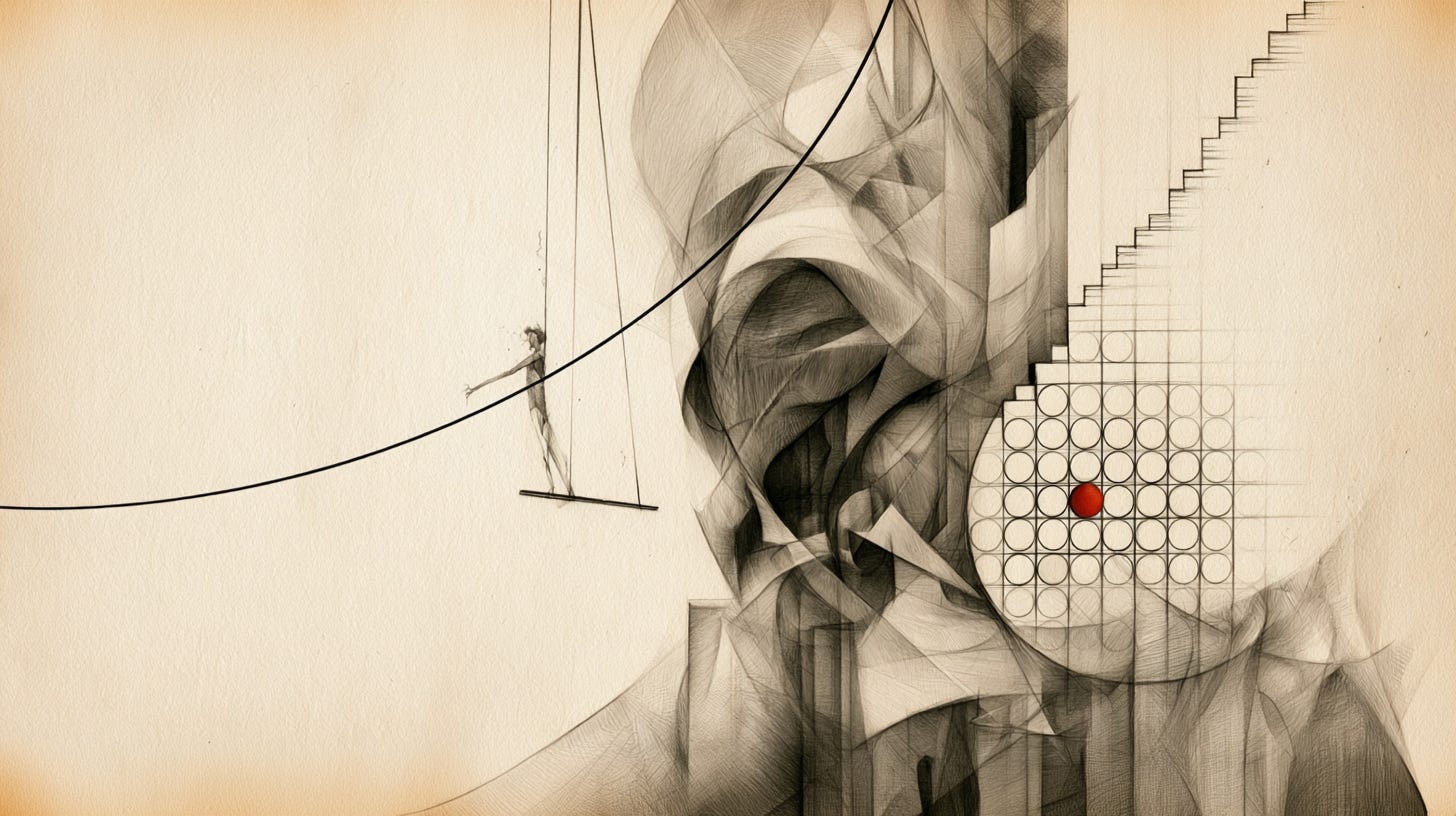
The net is out, and you are standing on the trapeze. I’m hoping you will jump.
Vjera is a dear friend and collaborator who recently asked me about vibe coding and unintentionally voiced the hesitation you are feeling now, so thank you :)
She said: ”I’m not vibing coding because I do think that you still need to understand a bit of coding in order to vibe code.”
So here is what I suggested:
The solution isn’t to make you a coder. Instead, it’s about understanding how to collaborate with our French dude or any of his friends, Ben style.
Meaning knowing when to stop. And that requires you to think in terms of systems. The smaller the system, the better. And here is why.
The problem with programming is that when you have no clue what is written, you need to anchor yourself somewhere.
So if you think of the code as a black box. Then, you better know really well what goes in and out of it.
And even then, you don’t have to do it alone. You can use AI to help you. Tell it to describe it, and now you have something that you can work against that you understand.
And with that understanding, you learn another thing. Where the boundaries are, so when the time comes to say NO, you know.
So to vibe code: Define the system. Edit the system. And only then, tell it to build. This is true whether you’re building a waitlist, a product, or a platform.
You are now ready to let go of the trapeze. Will you jump?
If you did, one word is sure to greet you: (Recommended). If you are not familiar, you will encounter it early, as you are defining the system or during the build.
It comes in the form of a menu. Option A. Option B. Option C. And next to one of them, a little tag: (Recommended).
I loved that for the first few iterations, and you probably will too. It took away my need to think, and it was easy. Yet at the same time it was the source of my frustration.
Because five weeks into capping Claude Fable every single week, something broke. I started to notice how often Recommended was not, in fact, recommended.
And just like that, fifteen years of software development came flooding back with anger. And NO became my go-to answer.
No, not like this. This is stupid. No, don’t do that took center stage.
And in a nutshell, this is the tension rising between those who know what good looks like and Artificial Intelligence.
And with it, a relationship is created. It surfaces here as resistance, but for most of you using AI for advice, emails, or board presentations, that tension hasn’t peaked yet, so it goes unnoticed.
And as of now, you are a clown standing in the middle of a ring with no whip, and the lions are about to eat you.
And by all means, they will because the debt is accruing regardless, and its ramifications will creep up on you out of nowhere.
So a fair warning to heed. Because by the time the shots are fired, the circus is over. And after 15 years, 5 weeks, and endless conversations on Human Behavior x Technology, these are the relationships to watch out for:
The first relates to Creativity. AI knows how to work. It will never know when to stop. So it will out-craft you before breakfast. It can generate a hundred options; it cannot want one of them. The wanting — the taste, the refusal of the other ninety-nine — is where creativity actually lives, and it is yours. Here your product or brand lives or dies.
The second comes for decision-making. AI can offer you options, but you have to know where the boundaries sit and what good looks like. Not picking an option from a menu, but holding options against a system you understand. No system, no measure. No measure, and whatever menu is in front of you quietly becomes the decider. That’s your governance fading.
The third hides in behavior. The relationship is real, and it’s being written whether you recognize it or not. Every session trains two models: the one on the server, and the one in your head. If the conversation becomes one-sided, something is lost, and it may just be you, not the model. This is where culture erodes, and it's the last thing you'll notice.
The relationship debt is building, and like technical debt, it accrues in your people rather than your codebase and compounds faster. And your AI ROI deck is the last place it will show up, if it ever does.
So if you don’t want to explore this alone, Vjera Orbanic and I have been working on this for a while now and would love for you to join the conversation; we have prepared a one-pager and an upcoming session to discuss this further with you. Drop your email at realitycheck.institute/the-hidden-debt-of-ai.
Looking back, it is always easier to omit the connective tissue that binds us and watch history as a fairy story rather than reality.
Every shift happens in the openings of hesitation and doubt, married with frustration. That’s where the questions that matter live. They don’t trust the certainty on display, but have faith in the blurry middle that keeps the wonder.
And today with AI, it is no different. So instead of answering, focus on the asking.
Because the future lives in understanding the relationships we hold and with whom, and that’s what will outlast this efficiency craze we are in.
So, which of the three is already showing up in your team: creativity, decision-making, or behavior?
Until the next time,
Carlo Mahfouz